A custom calendar only earns its keep if it lands in the right spot and stays there for twelve months. That makes format the first real decision, ahead of artwork or color. A wall calendar, a desk tent, a full-year poster, and a fridge magnet all do different jobs, occupy different spaces, and cost different amounts to print in quantity. Choosing the format that matches where your audience will actually use the calendar is what turns a giveaway into a year of quiet, daily brand exposure rather than a piece of recycling.
Matching the format to the job
Wall calendars are the default for a reason: a large, visible month grid that lives in a kitchen, break room, or office and gets looked at every day. The most common custom size shows an 11 by 17 inch page when hung, usually as a stapled or wire-bound book that flips monthly, and a thirteen-month layout is standard so January of the following year is already in place. If you want maximum visual impact and room for a photo plus a writable grid, this is the workhorse.
Desk and tent calendars trade size for proximity. A desk tent folds into a small A-frame roughly 8 inches wide and 6 inches tall that sits on a workspace at arm’s length, ideal when the calendar is a reference tool during the workday rather than a display piece. Poster and single-sheet calendars go the other direction entirely: a single large sheet, commonly 18 by 24 inches and sometimes larger, that shows the whole year at once. Posters read as design objects and suit planning-heavy environments, but they offer little writing room per date. Magnetic calendars are the small-footprint specialists, typically sized for a refrigerator around 8.5 by 11 inches or shrunk to a business-card magnet. Their advantage is staying power: a magnet that sticks to a fridge can outlast the year and keep a logo in view long after a paper piece would have been tossed.
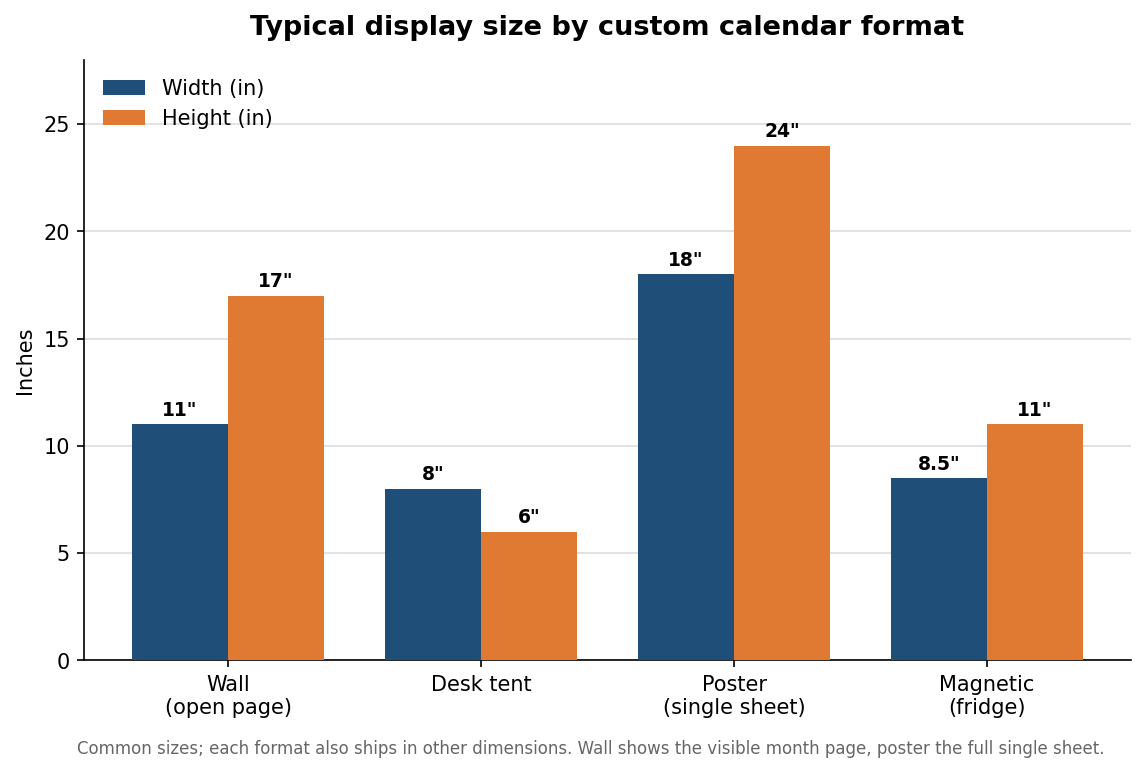
Notice how the footprints diverge. A poster commands wall space and attention; a desk tent disappears into a workspace; a magnet claims a few square inches but holds them for a long time. Pick the format for the room and the behavior you are targeting, not just for the lowest unit price, because a cheap calendar in the wrong place is money spent on nothing.
Paper, binding, and finish that decide feel and cost
Once the format is set, the print spec determines how the calendar feels and how long it survives. Inner pages commonly run on 70 lb uncoated stock for a matte, writable surface, or 80 lb to 100 lb gloss when photographs need to pop. Covers and single-sheet pieces move up to cardstock, often 10, 14, or 16 point, with the heavier 216 GSM range giving a desk or poster calendar the rigidity to stand up to a full year of handling. Finishes range from plain matte to gloss to a high-gloss UV coating that deepens color and resists fingerprints, which is worth considering for photo-driven designs.
Binding is both a look and a function. Wire-O uses a twin-loop wire spine through punched holes at the top, giving a polished appearance and pages that turn and lay flat cleanly month to month; it is the premium feel. Saddle stitch, which is simply stapling through the fold, delivers a classic look at the lowest cost and is the practical choice for high-quantity promotional runs. Spiral coil sits between the two on both price and durability. If the calendar hangs on a wall, also confirm there is a hanging hole or hook built into the binding so the recipient does not have to improvise one.
Thirteen months and the details worth specifying
A few small specification choices prevent the most common disappointments. Order a thirteen-month grid where you can, so the calendar remains useful into the first weeks of the following year and buys you a wider distribution window. Decide early whether dates need writing space, which pushes you toward uncoated or matte stock and a larger grid, or whether the piece is primarily visual, which favors gloss and photography. Confirm bleed and safe margins with your printer before art is finalized, and if the calendar will carry contact details or a promotion, keep them in a consistent spot on every page so they are never cropped or buried. These are the details that separate a calendar people keep from one that never makes it out of the box.
Timing and quantity for a bulk promotional run
The calendar business runs on a hard deadline: a January calendar is nearly worthless if it arrives in February. Working backward from a year-start launch, a comfortable schedule starts artwork in late summer, locks proofs by early fall, prints and binds through October, and leaves November and early December for mailing or handout. Building in that buffer matters because print shops queue up in the fourth quarter, so the same job that turns quickly in September can sit in line in November.
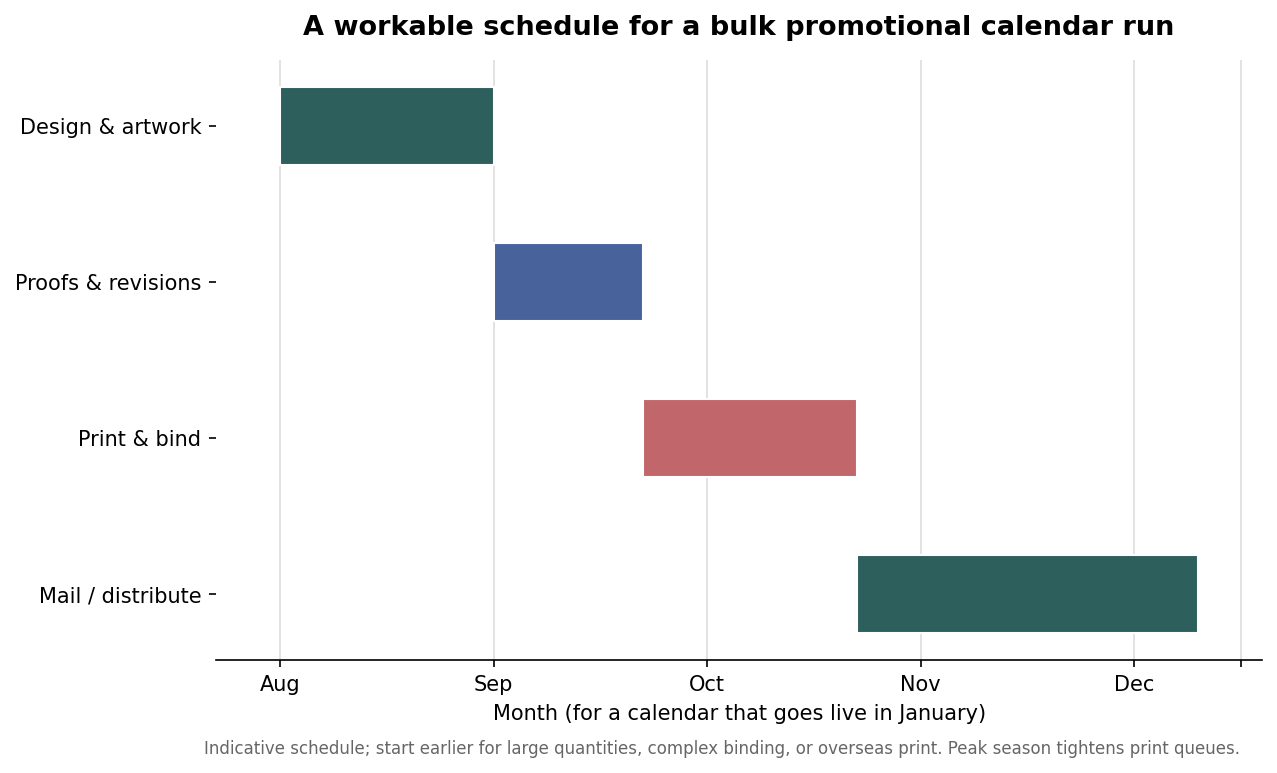
Quantity planning follows the same logic as any bulk print run: per-unit cost falls as volume rises, since fixed setup for plates, dies, and binding spreads across more pieces. Estimate distribution honestly, add a modest overage for reorders and replacements, and settle the format and binding before you request pricing, because those two choices move the number more than almost anything else. Nail the format for your audience, specify the paper and binding to match, and start early enough to beat the fourth-quarter crush, and a custom calendar becomes one of the few promotional pieces that works every single day for a year.