Two calendars can carry the same artwork and the same twelve months and still feel like different products, because most of what a buyer notices is decided before a single image is placed. Binding controls how the calendar hangs, how it turns, and how long it survives a year of daily handling. Paper controls how the printing looks and whether anyone can actually write on it. For a business ordering in volume, these two choices set both the perceived quality and the per-unit cost, and getting them right is far cheaper than reprinting a pallet that hangs crooked or smears under a ballpoint.
Start With How It Will Hang or Sit
The format decides the binding before taste ever enters the picture. A classic hanging wall calendar with the image on top and the grid below needs a single binding edge at the top and a way to hang, most often a hole drilled dead center at the top of the pages or a wire hanger built into a coil. A desk calendar wants to stand or lie open flat without a hand holding it down. A pocket or handout calendar wants to be thin, cheap, and mailable. Once you know which of those a run is, the binding shortlist narrows itself, and the standard 11 by 8.5 inch wall format that most promotional calendars use will fold open to a full 11 by 17 display.
Saddle Stitch: The Budget Workhorse
Saddle stitch is the folded-and-stapled construction behind most inexpensive calendars, and its economics are hard to beat for large promotional runs. Pages are folded at the spine and held with wire staples, the sheet lies open flat, and the whole thing mails easily and cheaply. The tradeoffs are real but predictable. Page count must be a multiple of four with a practical minimum around eight pages, so the format constrains your design, and the staples loosen with heavy repeated use over a full year.
Reach for saddle stitch when unit cost leads the decision. It is the natural fit for handout wall calendars, small desk pieces, and giveaway runs where you are printing thousands and every cent per unit multiplies. It is the wrong choice when the calendar needs to fold all the way back on itself on a desk, or when the piece is meant to read as a premium corporate gift.
Coil and Wire-O: Built to Be Used
When a calendar has to survive daily flipping, the two coil bindings earn their slightly higher cost. Spiral coil is a plastic coil threaded through punched holes and crimped at each end. It lets pages rotate a full 360 degrees and fold completely back, it lies perfectly flat, it carries no divisible-by-four page rule, and it comes in a range of colors to match a brand. Its durability is high, with only a small risk of unraveling if a crimped end fails. Wire-O, a double-loop metal wire, works on the same principle with a more rigid, polished look that reads as professional, at a higher price than plastic coil.
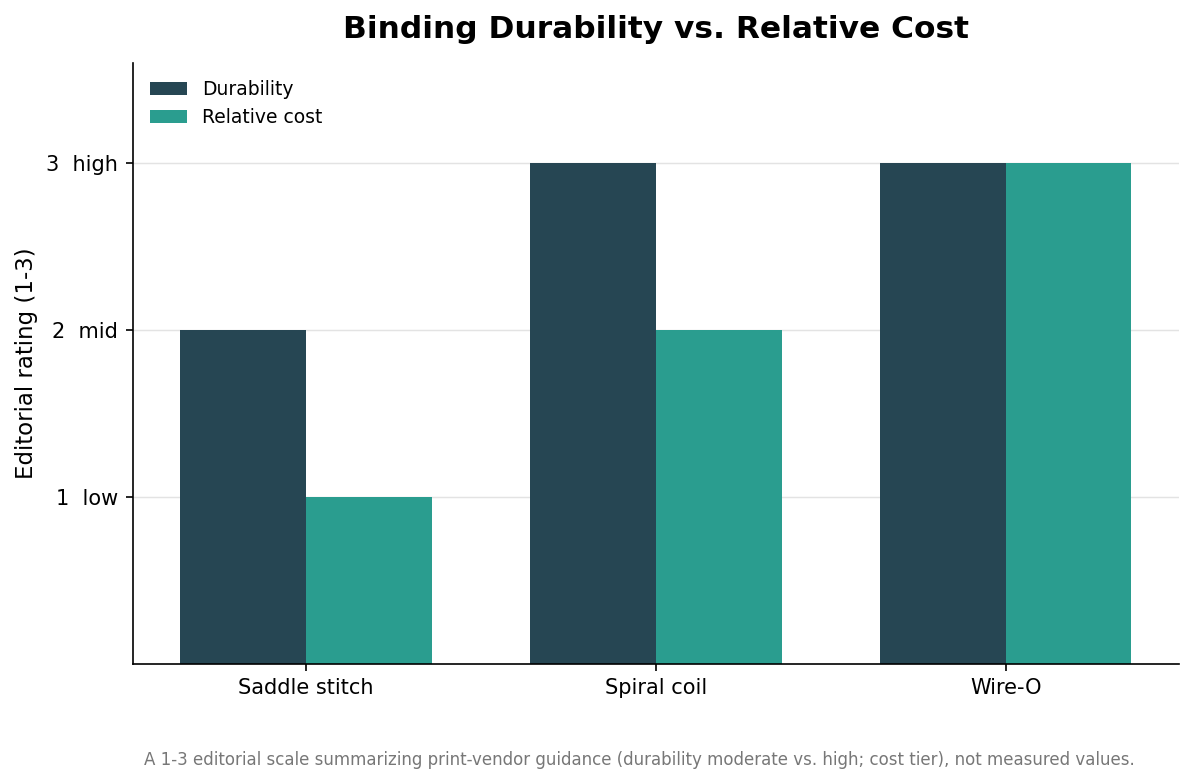
The choice between the two is mostly aesthetic and budgetary. Spiral coil is the value pick for wall and desk calendars in frequent use, including branded bulk orders where durability matters but cost still counts. Wire-O is the upgrade for corporate gifts and executive desk calendars where the metal binding signals that someone spent a little more. Both hang on a wall when paired with the appropriate hanger, which is why coil-bound wall calendars have largely displaced stapled ones anywhere the calendar is meant to last the whole year.
Paper: Weight and Coating Decide Feel and Writability
Calendar paper is described in two vocabularies that trip up first-time buyers. Inside pages are usually specified in text weight and the cover or backer in cover weight, and because those two scales use different basis sizes, an 80 pound text sheet is far thinner than an 80 pound cover sheet. Converting both to grams per square meter is the only way to compare them honestly, and it explains why the numbers on a quote do not line up the way you would expect.
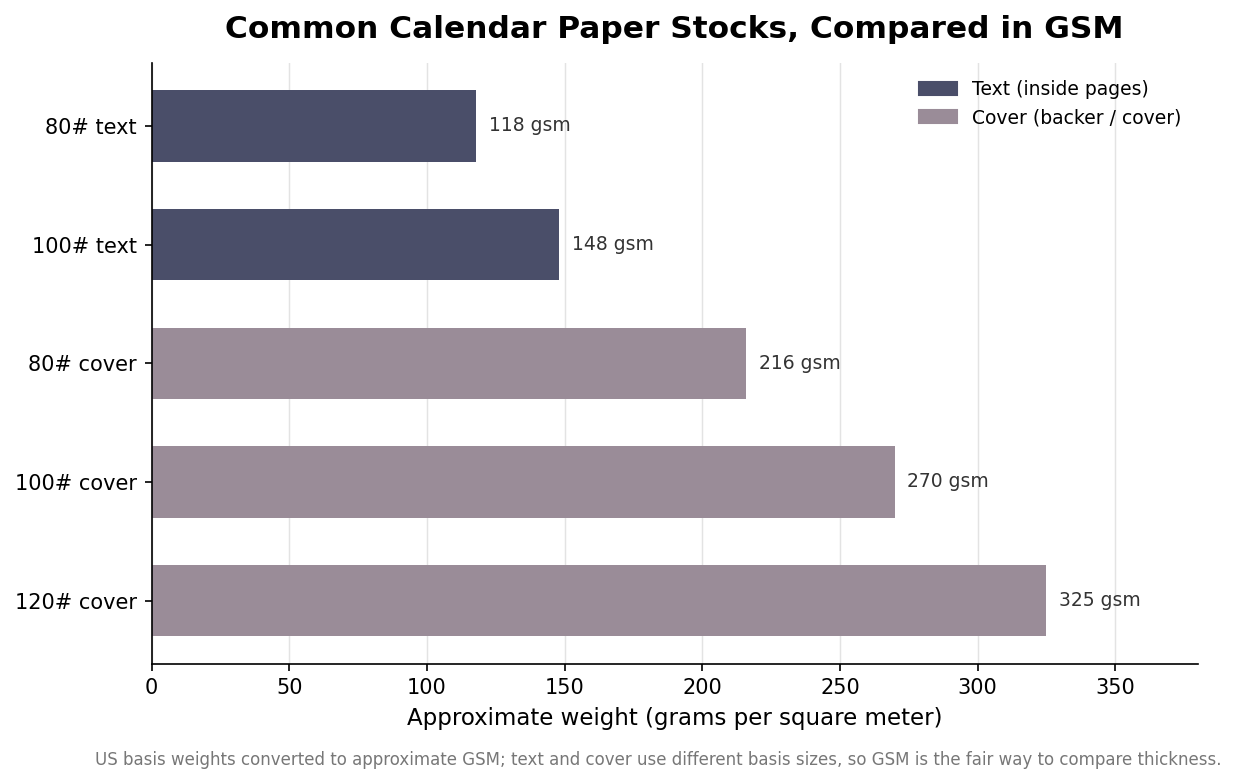
A common and reliable wall calendar build pairs roughly 100 pound gloss text pages with an 80 pound gloss cover, giving pages that feel substantial without making the piece heavy or expensive to mail. Heavier cover stocks up to 120 pound add rigidity for pieces that need to stand on a desk. The coating matters as much as the weight. Coated stocks in gloss, satin, or matte make photography and color pop, but they resist ink and are hard to write on with anything but a permanent marker. Uncoated stock takes a pen easily and is where most recycled options live, at the cost of slightly flatter-looking images.
The clever middle path is coated one side, or C1S. It puts a coated, photo-friendly surface on the face of each page and leaves the reverse uncoated, so the image prints sharp while the writing surface of the month below stays usable with an ordinary pen. For any calendar people are actually meant to write appointments on, that single specification prevents the most common complaint of all.
Finishing, and What to Put on the Order
A few finishing choices sit on top of paper and binding. UV coating adds gloss and protection but further limits writability, so it belongs on covers and image pages rather than grids. Soft-touch lamination gives a cover a velvety, premium hand that suits corporate gifts. Shrink wrapping protects pieces headed for retail or long storage. None of these are mandatory, and each adds cost, so specify them only where they earn their place.
Turning all of this into a clean order comes down to stating six things without ambiguity: the finished flat and open size, the binding type and, for wall pieces, the hanging method, the page paper as a text weight plus coating, the cover paper as a cover weight plus coating, whether pages are coated one side for writability, and any finishing such as UV or lamination. A quote built from those six lines is one a printer can hit exactly, and it is the difference between a calendar that looks and works the way the sample promised and a warehouse of pieces that photograph beautifully but nobody can write on.